Martinique in CARICOM: A Historic Lesson on the Limits of Assimilation and the Universal Value of Self-Determination by Mohamed Zrug.
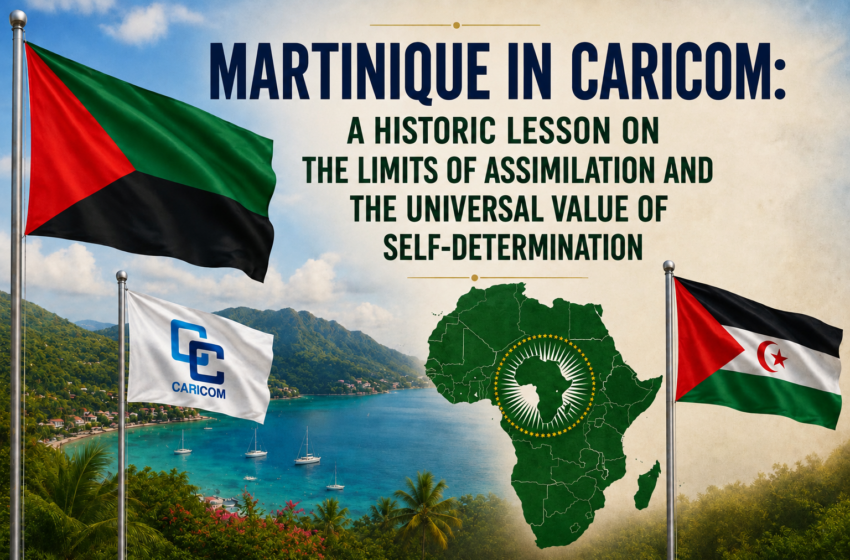
Martinique in CARICOM: A Historic Lesson on the Limits of Assimilation and the Universal Value of Self-Determination by Mohamed Zrug.
Due to its importance, Infosurglobal publishes the English version of the analysis by jurist and Ambassador of the Sahrawi Republic, Mohamed Zrug, prepared from Barbados on the occasion of the recent admission of Martinique as an Associate Member of CARICOM. The full text is reproduced below 👉🏻
Martinique in CARICOM: A Historic Lesson on the Limits of Assimilation and the Universal Value of Self-Determination
«Oppression cannot be reformed; it must be abolished.» — Frantz Fanon, son of Martinique.
The admission of Martinique as an Associate Member of Caribbean Community, announced during the Fifty-First Regular Meeting of the Conference of Heads of Government of the organization, taking place from 5 to 8 July in Saint Lucia and dedicated to reparatory justice, constitutes an event of particular political and legal significance for the Caribbean and for the international debate on decolonization.
Following the signing of the Agreement granting Martinique Associate Membership in February 2025, CARICOM received in June 2026 the Instrument of Accession transmitted by the French Republic, allowing the Agreement on the Privileges and Immunities of CARICOM to enter into force and enabling Martinique’s effective participation in the organization’s regional mechanisms.
This decision reaffirms CARICOM’s historic anti-colonial vocation and its commitment to the principles enshrined in the Charter of the United Nations, particularly the right of peoples to self-determination. Although Martinique remains legally a territorial collectivity of the French Republic, CARICOM has recognized its Caribbean identity, its historical distinctiveness, and its legitimate place within the regional community.
The decision also fits within CARICOM’s established practice regarding other Caribbean territories that remain under colonial administration. Its Associate Members include Anguilla, Bermuda, British Virgin Islands, Cayman Islands, and Turks and Caicos Islands—territories that continue to appear on the United Nations list of Non-Self-Governing Territories awaiting decolonization. The international community’s longstanding position regarding these territories is grounded in the application of the United Nations doctrine on decolonization and in the recognition of the right of their peoples to decide freely their political future.
Martinique, however, presents a particular case. France maintains that its annexation as an overseas department in 1946 definitively resolved its colonial status, whereas significant and diverse political and social sectors in Martinique argue that the question of self-determination remains very much alive. By granting Martinique Associate Membership, CARICOM does not prejudge the outcome of that debate, but it reframes it. By acknowledging—and therefore recognizing—that the identity of a people and its political aspirations cannot be ignored, its regional participation as a subject of rights constitutes a legitimate expression of belonging to the Caribbean community.
Martinique’s history offers a particularly timely reflection. From French colonization beginning in 1635, through the abolition of slavery in 1848, and the institutional transformation of 1946, the territory has undergone profound political changes. Subsequent reforms—including the contested institutional processes of 2003 and 2010 and the establishment of the Territorial Collectivity of Martinique in 2015—may have «expanded administrative powers», but they did not replace a genuine process of self-determination as envisaged by the Charter of the United Nations and the Declaration on the Granting of Independence to Colonial Countries and Peoples.
Nearly eight decades after departmentalization, the Martinican experience demonstrates that policies of forced assimilation and unilateral annexation may alter administrative structures, but they do not necessarily resolve the deeper aspirations of a people. The passage of time cannot substitute for the popular will, nor can solutions designed in metropolitan capitals be regarded as definitive when they have not resulted from an authentic exercise of the right to self-determination.
In this sense, Martinique offers us today a historical lesson projected into the future: false exits from decolonization processes do not transfer rights; more importantly still, they do not generate peaceful, democratic, or lasting solutions. The aspirations of peoples cannot be circumvented through legal and political formulas deliberately designed to prevent the full exercise of their rights.
This reflection acquires particular relevance in the case of Western Sahara. It is not consistent to defend the principle of self-determination while simultaneously maintaining that the solution should be confined to an annexation proposal advanced by the occupying Power. Such an approach seeks to exclude the legitimate option of independence. To present it as the sole possible basis for the political process, while placing the legitimate representatives of a people in a straitjacket, is to restrict in advance the Sahrawi people’s right to decide freely their future and to predetermine the outcome of a decolonization question, with incalculable risks for peace and security.
Historical experience has consistently shown that no «lasting solution» has ever been built upon the exclusion of the will of the people concerned, nor has any Power since 1945 been able to sustain indefinitely, through brute force alone, its occupation of another people. In this respect, self-determination is neither a negotiable element nor a transferable option, but rather the cardinal, inalienable, and imprescriptible legal principle that must guide every process of decolonization.
For this reason, Martinique’s accession to CARICOM carries a significance that transcends the Caribbean. It serves as a reminder that regional integration must either be reparative and restorative, or it is not genuine integration at all. It must coexist with the defense of international legality and with solidarity toward those peoples whose political and emancipation processes remain unfinished.
The same principle underpins the action of the African Union with regard to Western Sahara and its recognition of the Sahrawi Arab Democratic Republic as a full member of the organization. Both CARICOM and the African Union, from their respective regional perspectives, affirm the importance of accompanying decolonization processes and defending an international order based on rules, in which sovereignty, the equality of States, and the right of peoples to self-determination are universal principles rather than selective or transactional criteria.
At a time when multilateralism faces significant challenges, it is precisely small and medium-sized States that have a vital interest in preserving this rules-based international system. Their solidarity with decolonization processes is not merely an expression of historical commitment; in light of emerging threats, it has become a form of resistance against attempts to replace international law with the politics of accomplished facts.
Martinique’s lesson is clear: policies of forced assimilation, unilateral annexation, or the indefinite postponement of status quos born of the spoils of war and the servitudes of the past may create the false appearance that a people’s aspirations have been subdued or extinguished, but they signify neither defeat nor the disappearance of their legitimate claims. So long as there has not been an authentic and genuine exercise of the right to self-determination, the underlying issues remain unresolved, and the political movements that express them continue to form part of an undeniable historical reality. Lasting peace and genuine security can only be achieved when the freely expressed will of peoples occupies the central place in every solution that aspires to be even minimally just.
Mohamed Zrug
Jurist and Ambassador of the Sahrawi Republic
Barbados, 5 July 2026.
Infosurglobal
Due to its importance, Infosurglobal publishes the English version of the analysis by jurist and Ambassador of the Sahrawi Republic, Mohamed Zrug, prepared from Barbados on the occasion of the recent admission of Martinique as an Associate Member of CARICOM. The full text is reproduced below 👉🏻
Martinique in CARICOM: A Historic Lesson on the Limits of Assimilation and the Universal Value of Self-Determination
«Oppression cannot be reformed; it must be abolished.» — Frantz Fanon, son of Martinique.
The admission of Martinique as an Associate Member of Caribbean Community, announced during the Fifty-First Regular Meeting of the Conference of Heads of Government of the organization, taking place from 5 to 8 July in Saint Lucia and dedicated to reparatory justice, constitutes an event of particular political and legal significance for the Caribbean and for the international debate on decolonization.
Following the signing of the Agreement granting Martinique Associate Membership in February 2025, CARICOM received in June 2026 the Instrument of Accession transmitted by the French Republic, allowing the Agreement on the Privileges and Immunities of CARICOM to enter into force and enabling Martinique’s effective participation in the organization’s regional mechanisms.
This decision reaffirms CARICOM’s historic anti-colonial vocation and its commitment to the principles enshrined in the Charter of the United Nations, particularly the right of peoples to self-determination. Although Martinique remains legally a territorial collectivity of the French Republic, CARICOM has recognized its Caribbean identity, its historical distinctiveness, and its legitimate place within the regional community.
The decision also fits within CARICOM’s established practice regarding other Caribbean territories that remain under colonial administration. Its Associate Members include Anguilla, Bermuda, British Virgin Islands, Cayman Islands, and Turks and Caicos Islands—territories that continue to appear on the United Nations list of Non-Self-Governing Territories awaiting decolonization. The international community’s longstanding position regarding these territories is grounded in the application of the United Nations doctrine on decolonization and in the recognition of the right of their peoples to decide freely their political future.
Martinique, however, presents a particular case. France maintains that its annexation as an overseas department in 1946 definitively resolved its colonial status, whereas significant and diverse political and social sectors in Martinique argue that the question of self-determination remains very much alive. By granting Martinique Associate Membership, CARICOM does not prejudge the outcome of that debate, but it reframes it. By acknowledging—and therefore recognizing—that the identity of a people and its political aspirations cannot be ignored, its regional participation as a subject of rights constitutes a legitimate expression of belonging to the Caribbean community.
Martinique’s history offers a particularly timely reflection. From French colonization beginning in 1635, through the abolition of slavery in 1848, and the institutional transformation of 1946, the territory has undergone profound political changes. Subsequent reforms—including the contested institutional processes of 2003 and 2010 and the establishment of the Territorial Collectivity of Martinique in 2015—may have «expanded administrative powers», but they did not replace a genuine process of self-determination as envisaged by the Charter of the United Nations and the Declaration on the Granting of Independence to Colonial Countries and Peoples.
Nearly eight decades after departmentalization, the Martinican experience demonstrates that policies of forced assimilation and unilateral annexation may alter administrative structures, but they do not necessarily resolve the deeper aspirations of a people. The passage of time cannot substitute for the popular will, nor can solutions designed in metropolitan capitals be regarded as definitive when they have not resulted from an authentic exercise of the right to self-determination.
In this sense, Martinique offers us today a historical lesson projected into the future: false exits from decolonization processes do not transfer rights; more importantly still, they do not generate peaceful, democratic, or lasting solutions. The aspirations of peoples cannot be circumvented through legal and political formulas deliberately designed to prevent the full exercise of their rights.
This reflection acquires particular relevance in the case of Western Sahara. It is not consistent to defend the principle of self-determination while simultaneously maintaining that the solution should be confined to an annexation proposal advanced by the occupying Power. Such an approach seeks to exclude the legitimate option of independence. To present it as the sole possible basis for the political process, while placing the legitimate representatives of a people in a straitjacket, is to restrict in advance the Sahrawi people’s right to decide freely their future and to predetermine the outcome of a decolonization question, with incalculable risks for peace and security.
Historical experience has consistently shown that no «lasting solution» has ever been built upon the exclusion of the will of the people concerned, nor has any Power since 1945 been able to sustain indefinitely, through brute force alone, its occupation of another people. In this respect, self-determination is neither a negotiable element nor a transferable option, but rather the cardinal, inalienable, and imprescriptible legal principle that must guide every process of decolonization.
For this reason, Martinique’s accession to CARICOM carries a significance that transcends the Caribbean. It serves as a reminder that regional integration must either be reparative and restorative, or it is not genuine integration at all. It must coexist with the defense of international legality and with solidarity toward those peoples whose political and emancipation processes remain unfinished.
The same principle underpins the action of the African Union with regard to Western Sahara and its recognition of the Sahrawi Arab Democratic Republic as a full member of the organization. Both CARICOM and the African Union, from their respective regional perspectives, affirm the importance of accompanying decolonization processes and defending an international order based on rules, in which sovereignty, the equality of States, and the right of peoples to self-determination are universal principles rather than selective or transactional criteria.
At a time when multilateralism faces significant challenges, it is precisely small and medium-sized States that have a vital interest in preserving this rules-based international system. Their solidarity with decolonization processes is not merely an expression of historical commitment; in light of emerging threats, it has become a form of resistance against attempts to replace international law with the politics of accomplished facts.
Martinique’s lesson is clear: policies of forced assimilation, unilateral annexation, or the indefinite postponement of status quos born of the spoils of war and the servitudes of the past may create the false appearance that a people’s aspirations have been subdued or extinguished, but they signify neither defeat nor the disappearance of their legitimate claims. So long as there has not been an authentic and genuine exercise of the right to self-determination, the underlying issues remain unresolved, and the political movements that express them continue to form part of an undeniable historical reality. Lasting peace and genuine security can only be achieved when the freely expressed will of peoples occupies the central place in every solution that aspires to be even minimally just.
Mohamed Zrug
Jurist and Ambassador of the Sahrawi Republic
Barbados, 5 July 2026.
Infosurglobal